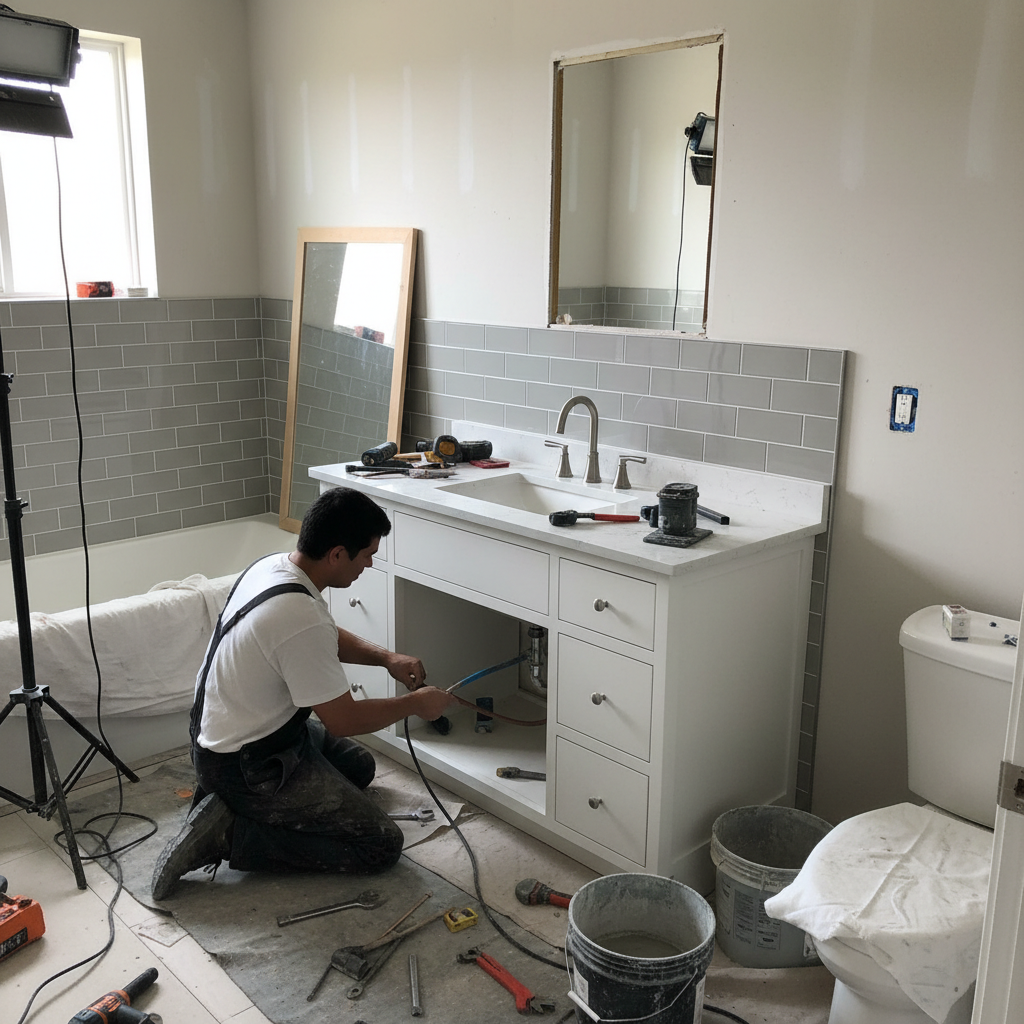
One of the most common calls I get in Orange County starts the same way: a homeowner notices the vinyl floor by the toilet feels a little soft, the caulk around the tub has gone dark again, and the vanity drawers stick every time the weather turns humid. It doesn't look like a full-blown disaster, but the bathroom feels tired, cramped, and older than the rest of the house. By the time they're ready to do something, they're worried a simple refresh is going to snowball into a huge bill.
Around Rockland and Orange County, I see the same pattern over and over, especially in homes built before 1970. A lot of these bathrooms were built tough, but they weren't built for today's moisture levels, heavier daily use, or modern storage needs. Nationally, bathroom remodels consistently rank among the top home projects for return and daily quality-of-life improvement, but the surprise for most homeowners is this: you don't need a gut renovation to make the room work better.
The good news is that a budget-friendly bathroom renovation Orange County NY homeowners can actually feel good about usually comes down to smart priorities, not cheap shortcuts. Keep the plumbing where it is, fix moisture problems first, spend money on surfaces you touch every day, and leave the trendy stuff for accessories. I've seen a $6,000 to $12,000 targeted update outperform a sloppy $20,000 remodel just because the planning was better.
Start With What Actually Needs Replacing
The fastest way to blow a bathroom budget is replacing things that are still perfectly serviceable. Before I price anything, I walk the room in a very simple order: water, structure, ventilation, then finishes. In plain English, that means I check for hidden leaks around the toilet base, probe the subfloor near the tub with an awl, test the fan, and look for cracked grout or failed caulk lines. A bathroom can look outdated and still be structurally fine. On the flip side, a fresh coat of paint won't save a subfloor that's gone soft around a wax ring.
Do a one-hour bathroom audit
Start by measuring the room wall to wall and fixture to fixture. In many older homes around Newburgh, Nyack, and Middletown, hall bathrooms are only 5 feet by 8 feet, so every inch matters. I like homeowners to note three numbers right away: vanity width, clear distance in front of the toilet, and tub or shower opening. A standard vanity might be 24, 30, 36, or 48 inches wide. A lot of people think they need custom cabinetry when a 30-inch or 36-inch stock vanity from KraftMaid, Home Depot Home Decorators Collection, or IKEA will fit fine with minor trim work.
Keep the plumbing where it is
This is probably the biggest money saver in the whole project. Moving a toilet flange even 12 inches can turn a cosmetic update into plumbing, flooring, patching, and inspection work. Keeping the tub, vanity, and toilet in the same footprint usually saves thousands. I tell homeowners to spend that money where they'll actually notice it every morning: better lighting, a quieter fan, a vanity with full-extension drawers, and a floor that doesn't feel cold and dated.
Fix moisture before you buy finishes
I've pulled out plenty of nice-looking vanities that were ruined from the back because of a slow supply-line drip. Replace old accordion sink drains with rigid PVC, use braided stainless steel supply lines, and install a proper bath fan sized to the room. For a typical 5-by-8 bathroom with an 8-foot ceiling, you're looking at 80 CFM minimum, though I often install a Panasonic WhisperCeiling 110 CFM if the room has poor natural ventilation. That's the kind of upgrade that protects everything else you spend money on.
Once you've separated true problems from cosmetic ones, the budget usually gets a lot easier to manage. Maybe the cast-iron tub stays, gets professionally reglazed, and the savings go toward tile, lighting, and a better vanity. That's how you make the room look like a real renovation without paying for unnecessary demolition.
Before demo starts, shut off the water and remove the toilet so you can inspect the flange and subfloor. Catching rot in a 12-inch by 12-inch area early is a lot cheaper than replacing half the bathroom floor later.
Homeowners often assume old tile or a dated vanity is the main problem, when the real issue is failed caulk, poor ventilation, or a slow leak hidden behind the sink.
High-Impact Upgrades That Stretch Your Budget
When homeowners tell me they want the room to feel new without doing a full gut, I focus on what changes the eye first. In most bathrooms, that's the vanity, mirror, lighting, wall color, and flooring. Swap those five things thoughtfully and the whole room feels different, even if the tub stays and the plumbing never moves. That's where a budget remodel wins.
Replace the vanity and top as one package
A stock 36-inch vanity with a quartz or cultured marble top gives you a lot of bang for the buck. I like quartz in bathrooms because it doesn't need sealing and holds up well around wet sink areas. A simple white or light gray top paired with a shaker vanity in navy, oak, or matte white gives a clean look that won't date itself in three years. Soft-close hinges and drawer glides are worth paying for. Cheap hardware is one of those things people regret fast.
Upgrade the lighting the right way
Bad bathroom lighting makes even a renovated room feel old. I usually recommend one 24-inch to 36-inch LED vanity light over the mirror at 3000K color temperature, plus a dimmable recessed light in the shower if the ceiling height allows. If the medicine cabinet is staying, a new framed mirror and side sconces can sharpen the whole wall. I've had homeowners spend $180 on lights and tell me it changed the room more than the tile did.
Use luxury vinyl tile or porcelain where it makes sense
For budget-conscious remodels, LVT from COREtec or Lifeproof can be a solid option in a powder room or lower-moisture bath if the subfloor is flat and the toilet gets reset correctly. In a full bath, I still lean toward porcelain tile for longevity. A 12-by-24 porcelain tile laid in a running bond pattern can visually widen a narrow room. Pair it with a grout like MAPEI Flexcolor CQ in a mid-tone gray and it hides everyday wear better than bright white.
Save the tub, refresh the surround
Not every outdated tub needs to be ripped out. If the tub is solid, reglazing or keeping it and replacing the walls with a clean, low-maintenance surround can save a lot. I've used Delta Classic 400 or tiled surrounds over cement board with RedGard waterproofing for homeowners who want a better look without the cost of a custom shower build. New trim kits in brushed nickel or matte black from Moen or Delta can make an older setup look surprisingly current.
Spend extra on the faucet and fan before you splurge on trendy wall decor. A solid Moen or Delta faucet and a quiet Panasonic fan will outlast cheap fixtures and make the room feel better every day.
Mixing too many finishes is a common budget remodel mistake. Pick one main metal finish, one floor, and one countertop color so the room looks intentional instead of patched together.
Materials That Hold Up in a Busy Bathroom
A budget renovation only works if the materials last. I've seen homeowners save a few hundred dollars on the wrong paint, bargain vanity, or thin flooring, then spend more fixing swelling, peeling, or water damage a year later. In bathrooms, durability matters more than showing off. The room gets hit with steam, splashes, hair products, cleaning chemicals, and constant temperature swings.
Wall and ceiling finishes matter more than people think
For paint, use a quality mildew-resistant bath formula like Benjamin Moore Aura Bath & Spa or Sherwin-Williams Duration Home in a satin or matte finish designed for humidity. Flat contractor paint on a bathroom ceiling is asking for trouble, especially in homes with weak ventilation. Prep matters too: patch, sand, prime stains, and caulk corner joints before painting. That's what keeps a bathroom looking crisp instead of tired after six months.
Build the tile assembly properly
When I tile a floor, I don't just look at the tile. I look at the entire sandwich underneath it. On wood subfloors, I want stiffness, proper fastening, and a crack-isolation or uncoupling layer when needed. Schluter Ditra is a great product for many bathroom floors, especially in older homes where seasonal movement is common. For shower walls, cement board or approved foam board with waterproofing is the standard. Tile and grout are not the waterproofing system. The membrane behind or under them is.
Choose water-friendly trim and cabinets
MDF can be okay in the right vanity, but cheap particle board near a wet floor is a headache waiting to happen. I prefer plywood-box vanities or at least better-grade furniture-style units with sealed interiors. For trim, PVC shoe molding near tubs and vanities can outperform primed pine in bathrooms that run humid. Even little details like sealing cut edges and caulking the base of the vanity where it meets tile help stop small water issues from becoming bigger ones.
Think about cleaning and maintenance now
This is where practical choices beat Pinterest choices. Tiny mosaic floor tile has its place, but it means a lot more grout to scrub. A frameless shower door looks great, but in hard-water areas it needs regular squeegeeing. Large-format wall tile, a skirted toilet, and simple chrome or brushed nickel fixtures are easier to maintain and easier to source parts for later. That's real-world value, especially in a family bathroom getting used every single day.
Use 100% silicone caulk, not painter's caulk, at all tub-to-tile, vanity-to-backsplash, and floor-to-tub transitions. It flexes better and holds up much longer in wet areas.
A lot of homeowners assume grout sealer or tile itself makes a shower waterproof. It doesn't. Without the right membrane and detailing, water still gets where it shouldn't.
Common Mistakes to Avoid
The first big mistake is starting with finishes before confirming the room is dry and solid. I've had people show me beautiful tile samples while standing on a floor that was flexing near the tub apron. Until the subfloor, flange, and ventilation are addressed, everything else is just decoration over a future repair. Budget remodeling doesn't mean skipping the boring stuff. It means handling the boring stuff first so the pretty stuff lasts.
The second mistake is buying fixtures online without checking rough-in dimensions. Toilets come in 10-inch, 12-inch, and sometimes 14-inch rough-ins. Vanities labeled 36 inches can actually measure 36 1/4 inches with the top overhang. Medicine cabinets may interfere with existing vent pipes or wiring in older walls. I always tell homeowners: measure twice, order once, and verify the spec sheets before you fall in love with anything.
Another common problem is poor sequencing. The right order usually goes demo, rough repairs, subfloor prep, wall repairs, waterproofing, tile, paint, vanity, toilet, trim, then accessories. When people paint first or install the vanity before flooring, they often create extra cuts, extra labor, and a messier final look. Good sequencing saves money because it reduces rework.
And finally, don't underdo the fan. In the Hudson Valley, between spring moisture and sticky summer humidity, a weak or noisy fan gets ignored and the room stays damp. That leads to peeling paint, mold spotting on caulk, and musty cabinets. A properly vented fan on a timer switch is one of the cheapest insurance policies in the whole bathroom.
Have your contractor or plumber verify toilet rough-in, vanity depth, and door swing before ordering materials. Ten minutes with a tape measure can save weeks of delays.
Keep the existing tub or shower valve body when possible if it's in good shape and compatible with a trim upgrade. Opening walls to change a valve can add a lot of hidden labor.
Cost Breakdown: What to Expect
For a realistic bathroom renovation Orange County NY budget, it helps to break the job into levels. A cosmetic refresh in a small hall bath, where the layout stays the same and the tub remains, often lands around $4,500 to $8,500. That's typically paint, vanity, top, faucet, mirror, lighting, toilet, basic flooring, and trim. A more complete renovation with tile floor, waterproofed tub surround, fan upgrade, and moderate plumbing or electrical improvements often falls in the $9,000 to $18,000 range, depending on material choices and what we find behind the walls.
DIY costs can look attractive at first. A homeowner might spend $1,200 to $3,500 on paint, a vanity, toilet, lighting, and click-lock flooring in a very simple refresh. But once tile work, plumbing resets, wall repairs, or waterproofing enter the picture, mistakes get expensive fast. One leaking shower niche or one poorly set toilet can wipe out the savings. I usually tell homeowners to DIY the painting and hardware if they're handy, but leave waterproofing, tile layout, plumbing connections, and electrical to pros.
Labor rates in Rockland and Orange County vary by trade, but as a ballpark, handyman and finish carpentry labor often runs around $85 to $125 per hour, licensed plumbing commonly ranges from about $125 to $200 per hour, and licensed electrical work often falls between $110 and $185 per hour. Tile installation is frequently priced by the job or square foot, with straightforward porcelain floor installs often landing roughly in the $15 to $30 per square foot installed range, while custom shower tile work runs much higher. Demo, debris removal, permit needs, parking access, and older-house surprises all affect the final number.
Here's where the money usually goes in a mid-range small bathroom: vanity and top $700 to $2,000, toilet $250 to $700, faucet and drain $150 to $450, lighting $150 to $600, fan $180 to $450 plus installation, flooring $400 to $1,500, tub surround or tile walls $1,500 to $5,500, paint and trim $300 to $1,000, and labor for installation and coordination $3,500 to $8,000 or more. The best way to control cost is simple: keep the layout, choose stock sizes, and make decisions early so the job doesn't stall waiting on backordered parts.
Choose a stock 30-inch or 36-inch vanity, standard 12-by-24 tile, and an in-stock toilet from a major brand. Special-order items can add both cost and schedule delays.
Replace old shutoff valves and supply lines during the renovation. It's a small added cost now and can prevent leaks that damage your new vanity and flooring later.
📍 How This Applies to Homes in Rockland & Orange County
Bathroom work in Rockland and Orange County has its own personality. Homes in Nanuet, Spring Valley, Suffern, Nyack, New City, Middletown, and Newburgh often have bathrooms tucked into older floor plans, with tight clearances, plaster walls, and framing that's seen a lot of seasons. In pre-1970s homes especially, I pay close attention to uneven floors, cast-iron drains, old galvanized supply lines, and bathroom fans that either vent badly or don't vent at all.
The Hudson Valley climate plays a bigger role than people think. Harsh winters and freeze-thaw cycles can create subtle movement in older homes, which shows up as cracked grout, small tile shifts, and caulk joints that open up around tubs and backsplashes. Then spring moisture rolls in, summer humidity hangs around, and any weakness in ventilation gets exposed fast. That's why I lean hard toward proper waterproofing, good exhaust fans, mildew-resistant paint, and materials that can handle seasonal change.
In towns along the river like Nyack and Newburgh, and in many established neighborhoods in New City and Suffern, I've seen bathrooms where the finishes weren't the real problem at all. The issue was trapped moisture behind old tile, soft subfloor near the toilet, or a fan ducted into an attic instead of outside. A budget update in these homes still needs to respect the bones of the house. Do the moisture and structural work first, then make it look good.
For homeowners in Orange County and Rockland, the smartest bathroom renovation isn't always the flashiest one. It's the one that fits the house, survives the seasons, and doesn't create maintenance headaches by next winter. In this area, that usually means keeping the layout efficient, choosing durable finishes over trendy ones, and building the bathroom so it can handle cold snaps, damp springs, and sticky August afternoons without falling apart.
Frequently Asked Questions
Ready to Get Started?
Get Your Free Estimate Today
Serving Rockland County & Orange County, NY. Professional results, guaranteed.
Request a Free Estimate →